AI is rapidly transforming how people get hired for jobs. Though many future implications of AI in hiring are uncertain, some of those changes are worth knowing about and adapting to, whether you’re applying for jobs now or thinking further ahead. This article looks at three: how employers use automated systems (increasingly with AI) to screen applications, how you can use AI to help you apply, and which skills are gaining value as AI takes on more work.
Applications are increasingly screened by AI
Applicant tracking systems (ATS), which automatically scan resumes, cover letters, and application questions and pull out the information on them, have been in common use for well over a decade. What’s newer is that many now have an AI layer on top, one that makes substantive judgements about candidates rather than just sorting their data.
The good news is that, in practice, ATS programs are unlikely to make the final call on your application, whether AI-assisted or not. Recruiters tend to report that the majority of applications receive human review (though the quality of data is low). The main exception seems to be “knockout questions,” the yes/no questions in application forms that ask about things like work authorization, required qualifications, or minimum years of experience. So long as you meet these, your application will most likely be looked at by a human.
However, this human assessment will be filtered by what the ATS is able to understand about your application, and any potential “fit” score it assigns you, which is increasingly being handled by AI. Given how little time hiring managers can usually spend on each application, it stands to reason that low-scoring applications, and applications that don’t meet important criteria not already screened out, are barely considered before being rejected. And though not every employer uses these scores, they’re common enough that you should assume they will play some role and plan accordingly.
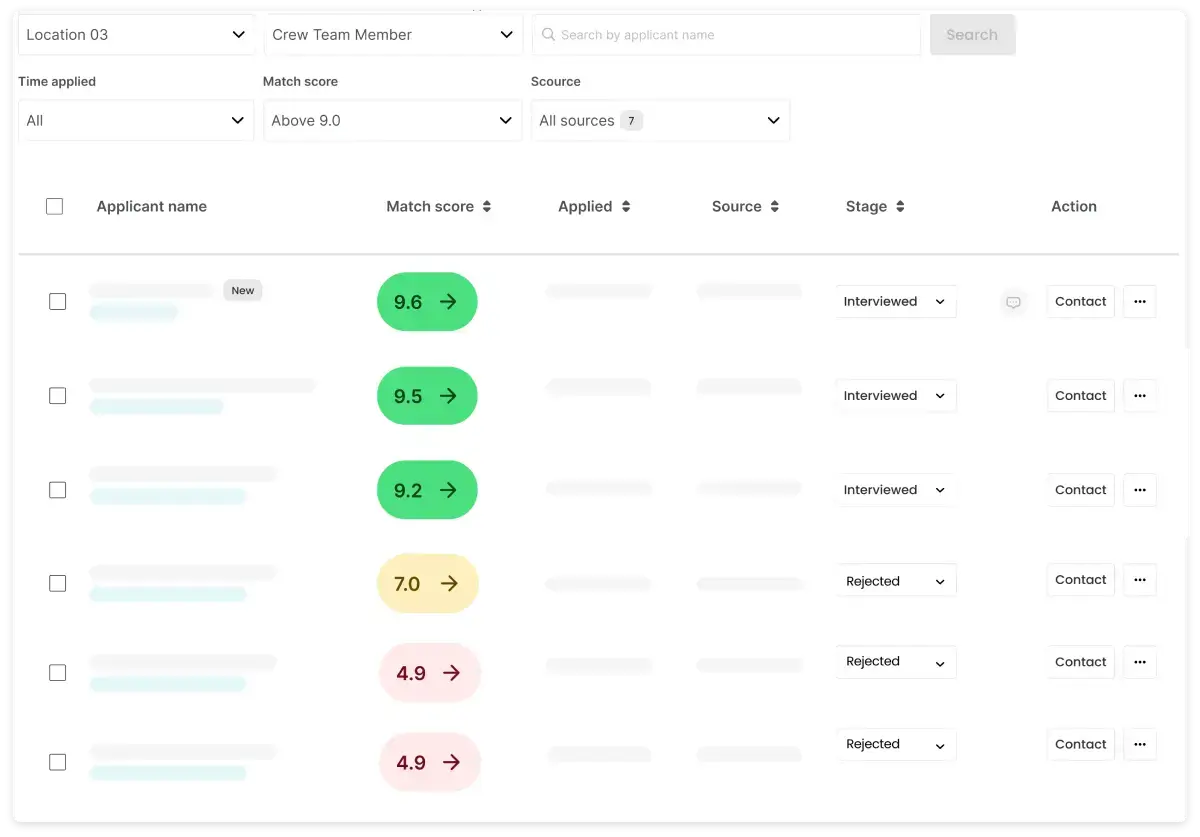
The problem, though, is that sometimes applicants are good fits for these roles, but aren’t flagged as such by the automated hiring systems, meaning strong applications get discounted for largely avoidable reasons. Some important pointers to avoid this happening to you:
Explicitly flag essential criteria. It’s safe to assume that if the applicant tracking system doesn’t think you meet some important criteria, this will tank your score. This makes it important to be explicit about how you meet these criteria — don’t assume that it’ll be correctly inferred. For instance, if it asks for five years in a field and you have them across a few roles, say so directly.
It matters where a skill appears. Many ”fit” scoring systems weigh placement in your resume. A skill listed at the bottom tends to count for less than one in your most recent job title or a line near the top. Some systems also explicitly weigh recent experience over old experience. If a key qualification only shows up against a job from years back, it may count for less than you’d hope. So where it’s still true, show that the skill is current.
Mirror the job description’s language. Fit scores are often generated by matching your resume against the exact terms the advert uses. So where the description uses a specific phrase, it’s worth using their word for it rather than your own. This might mean writing “experience in a BSL2 laboratory” over “experience in a laboratory researching human diseases” if that’s the terminology they’re using. Some systems can recognise that two phrasings mean the same thing, but plenty of employers still run older keyword-based tools, so matching their language is a safer bet. Don’t overdo it, though; keyword-stuffing reads badly to the human who eventually looks, and many systems now flag it.
Use simple formatting. Whether or not AI is involved, applicant tracking systems have to pull the information off your resume, but they often mess up, especially with unorthodox formatting. Ways to help the system read you correctly include sticking to a single column and avoiding tables, sidebars, images, and anything tucked into headers or footers, since these tend to get missed or scrambled. Be especially wary of pre-made templates from design tools like Canva; one 2026 test found around 72% of them failed basic parsing.
AI can help you with your applications (but be cautious)
If you’re applying for jobs, you’ve probably already wondered how much of the work AI can do for you. The answer is some of it. There are all sorts of ways to improve your chances of landing a job, like tailoring your resume and writing better cover letters. AI can help with all of these. The important thing, though, is not to entrust the whole application process to AI.
Most hiring managers are now flooded with AI-generated applications, and for the most part, the lazy ones are easy to spot. AI-written applications also often sound very similar to one another; if you’re just letting AI do the work for you, you’ll struggle to stand out from the many others doing the same. And if your application is perceived as low-quality AI use, employers may doubt whether you’ll be able to use AI well within the role (or take shortcuts elsewhere). This means that if you just submit an AI-written application, you likely won’t get an interview, and you may also harm your reputation for future applications.
However, using AI well can be genuinely useful. Here are a few tips on what you should do, and what you should avoid.
Do:
- Use AI to catch typos and grammatical errors.
- Ask it how to present your experience so it lines up with the job description.
- Use it to identify the important keywords in a job advert.
- Make significant edits to anything it produces.
- Ask it for likely interview questions so you can practice.
Don’t:
- Use AI if the hiring process explicitly forbids it (always check first!).
- Ask it to write cover letters or answer application questions without telling it, in detail, what you want to say.
- Submit anything you haven’t read carefully and corrected to match your real thoughts and experience.
The general point is that AI can help you put together a better application, but it can’t put one together for you. The ones that work are still the ones where your own experience and thinking come through.
It’s worth noting this matters particularly for the sorts of roles we highlight on our job board. Highly mission-oriented organizations are more likely to ask open-ended application questions to gauge your alignment and ability to reason through problems in a specific way. These need to represent your real thinking, and a generic AI response is unlikely to do a good job.
If you’re looking for an example of using AI well, below we provide a couple of ways you can use AI with your application materials to strengthen them for a specific application.
Two quick tests might be worth running before you submit. First, check that the text in your resume can be extracted well by the ATS: open your PDF resume (or other application document), select all, copy, and paste it into a blank document. If the text comes out jumbled, out of order, or missing sections, an applicant tracking system will likely struggle with it too, so you should simplify the formatting. Don’t rely on an AI chatbot to judge this for you: they usually read messy layouts better than standard ATS parsers, so it will often reconstruct your document correctly and reassure you when a real parser wouldn’t.
Second, use an AI tool to check your materials, including resume, cover letter, and answers to application questions, against the job description and diagnose any potential improvements. Here’s an initial prompt you can use:
You’re helping me pressure-test a job application. Don’t rewrite my materials. Give me a diagnosis and specific suggestions I can apply myself.
First, acting as an applicant tracking system: from the resume text below, tell me (a) any acronym I haven’t spelled out at least once; (b) for each essential requirement in the job description, whether I clearly demonstrate it or leave it to inference, and flag any key skill that only shows up in an old or low-down role, since placement and recency are weighted; (c) any important terms from the job description that I haven’t used anywhere.
Then, acting as a hiring manager: tell me where my cover letter or answers read as generic or AI-written, whether they engage sufficiently with this particular role, any places where I make vague or inflated claims that a concrete example or number would strengthen (point to each, but don’t invent facts for me), and whether there are any typos or grammatical errors. Finally, list the changes that would help most, and point out anywhere I’ve overdone the keywords.
[Paste the job description, your resume as text, and your cover letter or application answers if relevant.]
Some skills and traits are becoming more valuable
It’s also worth thinking about which skills are gaining value as AI takes on more work. AI is good at knowledge work, especially tasks with clear parameters and quick feedback loops. Coding is perhaps the prime example: it’s intellectually complex, but easy to test, and there’s plenty of quality data out there for AI to learn from.
It helps to think in terms of tasks rather than whole jobs. As it currently stands (in mid-2026), very few roles are automatable end to end, but almost every role contains some tasks AI can now do, and professions made up of more of these tasks are more exposed to AI than others. So far, though, there isn’t much clear evidence of job replacement attributable to AI, and there’s large disagreement about exactly how AI will reshape the labor market over time.
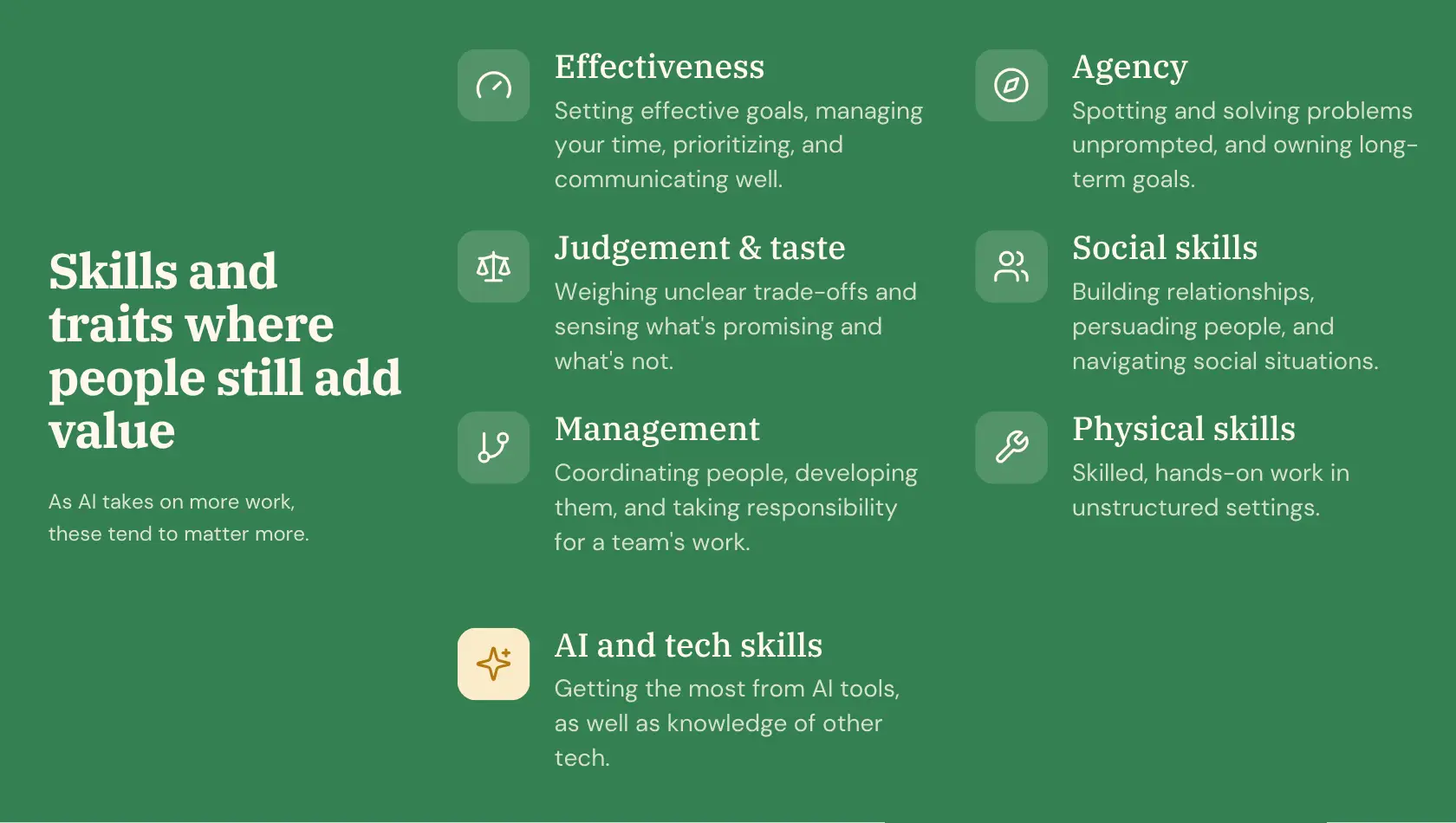
However, the broad direction of what work AI will take on looks clear enough to start working out how we might adapt, developing skills and traits that will remain valuable even with a shift to more AI-automated labor. We have some ideas of what these might be by inferring from where AI is currently at, and what its capabilities are likely to be in the near future:
- General effectiveness. Developing behaviors that help you get more done and at a higher quality: things like setting effective goals, managing your time, prioritizing tasks, and communicating well.
- Agency. Proactively spotting problems and solving them without being told to, and owning loose, long-term goals.
- Judgement and taste. Making solid calls on strategy and priorities, weighing unclear tradeoffs well, and generally having a good sense of what’s promising and what’s not.
- Social skills. Building relationships, persuading people, and navigating social situations.
- People management. Coordinating people, helping them to develop, and taking responsibility for a team’s output.
- Physical skills. Robotics is not yet as advanced as AI, so skilled, hands-on work, especially in unstructured settings, will likely be automated later than knowledge work. (However, more routine manual work is more easily automated.)
- Using AI and other technical tools well. Knowing how to get the most out of AI tools, including knowing when to use them and when not. This includes LLMs as well as other applications, which will increasingly incorporate AI and likely become more effective, and important, to doing good work. More broadly, tech-focused roles look set to increase, increasing the value of other kinds of technical knowledge.
It’s hard to predict how AI will change work over the next few years, and even the people who study it closely disagree. So we wouldn’t put too much weight on any single prediction about which jobs are safe, or how it will change the hiring process. Nonetheless, we think the pointers here should serve you well given what we know now.