“If you need your working day to be fulfilling, if you need to feel like you’re making a difference, trust that voice, because it means you have the passion to actually make a difference in the world. Pursue it, because we need more people with that passion doing good work.”
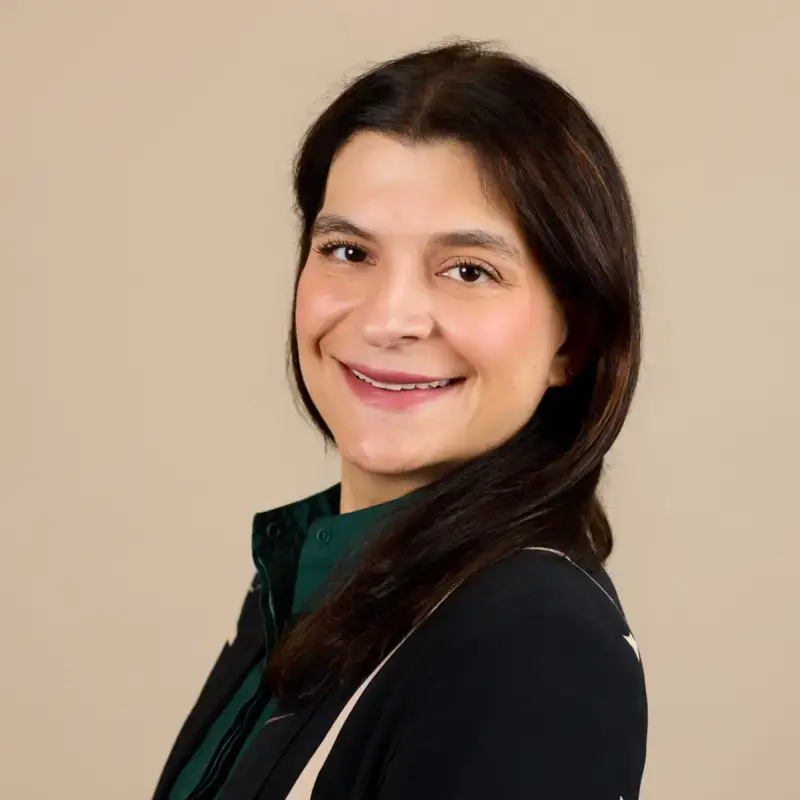
Maha Bazzi is the Director of Animal Welfare Initiatives for the U.S. and Canada at Mercy for Animals, where she oversees the Corporate Campaigning and Corporate Engagement teams working to push food companies to adopt higher animal welfare standards.
But before finding her way into animal advocacy, Maha trained as a graphic designer, worked in design for several years, taught English as a second language in New York, and eventually completed a master’s in animals and public policy before getting her first animal advocacy role.
We had the pleasure to talk to Maha about how she got to where she is now. Things we touch on include how seemingly unrelated skills can complement each other, the skills the animal advocacy movement most needs, and how to navigate a big career pivot when your current work isn’t fulfilling you.
From a bird’s-eye view, could you describe what you’re currently doing at Mercy for Animals, as well as what your day-to-day looks like?
Currently, I’m the Director of Animal Welfare Initiatives for the U.S. and Canada at Mercy for Animals, which means I oversee two departments—our Corporate Campaigning department and our Corporate Engagement department. On the corporate engagement side, we engage with hundreds of companies, meet with them about their animal welfare policies, push for transparency, and track their progress—internally and publicly—to get them to publish what they’ve done and how far they have to go. When negotiations don’t lead to progress and companies aren’t moving, that’s where public pressure comes in. The campaigns team runs public awareness campaigns to educate people about companies that are falling behind and to increase the reputational risk of not following through, to get them back to the table.
On a day-to-day basis, I’m communicating with our campaigns and corporate engagement managers about where our conversations with companies stand. I’m evaluating ongoing campaign strategies, tracking progress, and flagging blind spots. I’m talking to our development team and leadership about progress made, and making sure the narratives we’re presenting allow us to communicate effectively externally—in a way that isn’t too technical and that really tells the story of these animals and how we’re trying to help them.
I also have a lot of coalition meetings, touching base with other organizations in the movement to make sure our work in Canada and the U.S. is coordinated and that our efforts are complementary. I’m responsible for setting and tracking budgets, reviewing written content to make sure we’re following messaging guidelines, and keeping animals at the center of the stories we tell. And I meet with one or two companies a week with our corporate relations manager to lend support during negotiations.
What’s it like working with so many partner organizations?
I love it, personally—I think that’s the most fun part of the job. It’s where you really grow your thinking around campaigning and engagement strategies. We each play a unique role in the landscape of animal welfare and animal rights, and all those unique roles lend themselves to different parts of the overall strategy. Mercy for Animals has a kind of good cop/bad cop approach—our corporate engagement team engages with companies and tries to avoid triggering a campaign, while the campaigns team runs campaigns if those negotiations fail. Other groups may be purely campaigning organizations and sometimes even more aggressive in their approach, and that’s great, because it plays a different role in the landscape.
I think that collaboration is actually essential to driving progress. If we all did things the same way, there’d be no need for the diversity—and I think there is a real need for different approaches, different strategies, and us learning from each other.
You studied graphic design at university. What did you have in mind for your career at the time?
Honestly, I had nothing in mind. I grew up wanting to be a doctor, and that was the direction I was heading my whole life. I’m French-educated, so in high school you had three tracks—economics, science, or literature—and I did science: biology, chemistry, physics, math. That was the trajectory I was on going into pre-med. But the French system is really rigorous, and I got burnt out by the sciences. I felt like I’d gone through a university degree by the time I graduated high school and completed my baccalaureate. So while I got into pre-med, I also thought, on a whim—I’ve never explored the creative side of myself, I’ve never allowed myself creativity because I was so focused on the sciences. My sister’s best friend was in a graphic design program at the university, and I was seeing the work she was coming out with and couldn’t believe she was learning how to create art and design like that. I thought it was an area that could let me explore creativity, and I went into it thinking I’d use the first year as a trial. If I don’t like it, I’ll transfer.
And I got into it and really liked it—I was good at it and really enjoyed it, especially because the program was very focused on design for advocacy. We would choose social justice issues in our community, and it wasn’t just about learning to design and center things on a page. It was mostly about designing campaigns that would address a real issue, which involved homing in on writing skills, building the marketing message, and coming up with a full campaign—advertising, messaging, articles. It was very holistic in nature. I didn’t realize at the time that I enjoyed it because of the advocacy component. I just thought it was fun to learn new skills and become a good designer. I graduated with distinction, one of two in my class to do so.
Where did you go after you graduated?
From there, I moved to the U.S. to pursue a master’s in design at Pratt Institute in New York. I wasn’t really ready to enter the workforce, wasn’t sure which side of design I wanted to get into, and really wanted to move to New York and see what was possible. The master’s was a two-year program focused on packaging design and marketing. I did two internships throughout, so I was working while expanding my skills. I graduated in 2012 and joined a company as an in-house designer for a real estate agency. I did that for about three and a half years and really did not enjoy it.
In the middle of all that, I took a two-month sabbatical—went volunteering in Ecuador, and worked in the Amazon rainforest and the Galapagos Islands on conservation projects. I really loved that. When I came back, I decided I wanted to explore a career that had more purpose, and a friend pointed me toward teaching. Around that same time, I became vegan. I started a program in teaching English as a second language while still working in design, keeping that option in my back pocket until I was ready to make the jump.
When I finally decided to leave design, I felt like I wasn’t pursuing a meaningful career. The work was dry, I didn’t feel like I was driving impact, and I didn’t feel surrounded by people who were mission-oriented. I was slowly realizing I needed to be advocating in some capacity, or at least around people who were more passionate about what they were doing. So I left my design job on a Thursday and started teaching on a Monday.
That’s a big change. How did you find it?
I absolutely loved it. Teaching English as a second language to students from all over the world who came to New York—some of them would enter my classroom not speaking a word of English, and three months later they were having conversations. It was extremely fulfilling, but it didn’t pay well, and I needed to build something more. During those three years of teaching, I became more entrenched in veganism and started learning more about animal rights and roles in the movement.
Eventually, through talking to a life coach, I came to the realization that I wanted to be helping animals—but I didn’t know how. Coming from an immigrant family with a very education-centric mindset, I felt like I needed to go back to school to get the foundation I needed to enter the field.
So I then pursued a master’s from Tufts University in animals and public policy, which opened my mind to different sides of the movement—wild animals, companion animals, farmed animals—and the different approaches available, from corporate campaigning to legislation to lobbying.
It was the farmed animal module that really struck me. The scale of suffering, the conditions for chickens raised for meat and for laying hens—I remember feeling extremely emotional in that class and having a lightbulb moment: I think I should be working to help farmed animals. It was about a nine-month program, and it gave me a really solid foundation.
During the program, I did an externship with an organization called World Animal Net, which brings different groups together and creates platforms for them to collaborate on international policy for animals—things like influencing the sustainable development agenda at the UN. I wrote position statements about the linkages between farmed animals, wild animals, climate change, food security, and food safety. I stayed with that organization after graduating for about half a year, but I had my eye on work with more immediate impact. When you’re working in UN forums, the work takes time and you rarely get to witness direct change. I really wanted to be tied to something I could measure.
Then a role came up at Mercy for Animals for a campaign specialist. I applied, got the role, and joined as a campaigner. I was very fresh, and not entirely sure what campaigning entailed. But I had all the writing skills I needed, and with my design background I could creatively direct the design team. I was drawing on research skills from both my master’s programs to support the messaging I was putting out. I had a holistic understanding of all the different sides of the work without quite realizing how they all came together for a role like this. And I absolutely loved it.
From there I grew into the role, joined World Animal Protection briefly to do some campaigning there, then came back to Mercy for Animals to manage the campaigns team—and eventually my role expanded to include managing corporate engagement as well.
Your degree was quite focused on advocacy and running campaigns. Is that true of graphic design courses more broadly, or was it unique to your program?
I think it was unique to my program, to be honest. I went to the American University of Beirut, and a lot of the design we were doing was rooted in the vernacular—in Lebanon you see Arabic, French, and English signage all at once, and there’s such a rich history and so many live issues in the culture and community. The professors at the time were very involved in their communities and passionate about change. Students would build campaigns around domestic violence, pollution, surveillance on the streets. We were very encouraged to explore and find solutions. The culture and history of Lebanon, the good and the bad, lent itself to the program being built that way.
My program in the United States was very different—much more focused on concrete technical skills, learning to set typography, being creative in a more formal sense—but it wasn’t rooted in projects where the typography had to make someone feel something because it was responding to conflict or crisis. Different culture, different landscape completely.
What was your experience like in the master’s program? Is it a credential that’s valued within animal advocacy, or were you pursuing it mainly for the skills?
It was for the skills I developed. I honestly can’t tell whether having it on my resume opened doors—it likely did—but I know a lot of people in my organization who learned everything on the job and had transferable skills that allowed them to become campaigners or be effective at corporate engagement. We have designers, we have developers who build websites—people who bring their existing skills to this work and make a real difference. That’s why I always say: I was privileged to be able to go back to school, but there are so many other ways to enter this field. Think about what skills you have and how you can apply them within the movement. We need good designers, great editors and writers, people who can do research and distill scientific knowledge in a way that serves the work.
For me, given the way I learn and the confidence I needed to enter the field, the master’s really served me. But we need more advocates—more people in this movement who care about animals and want to drive progress—and we don’t necessarily need people with master’s degrees. We need people who care, who have passion, and who are skilled at telling stories, at marketing, at communicating, at public relations. A lot of people in the movement didn’t come from this field at all and were still able to apply what they knew to it.
You seem to have the ideal confluence of skills and experience for this kind of work. But it sounds like this wasn’t necessarily intentional?
I would say it was like the universe was conspiring to get me somewhere. The pieces fit together in ways I didn’t understand at the time. I think it wasn’t until maybe two years ago, when I came back as campaigns manager, that someone said, “You have such a good eye for design—it’s so easy to work with you on creative feedback.” And I said, yeah, because I have a design background. And I had this aha moment: my undergraduate program was very social issues-centric, and all these different paths I took—even the teaching, which was really about distilling information in a way people can understand, writing things that aren’t too technical, explaining ideas clearly—all of that is so important in my role now. Even as a spokesperson, you have to be able to publicly express ideas in an accessible way. All these different parts of my career led me here somehow—through fortune, but also in a way that was somehow calculated without me realizing where the path was going.
I feel so fortunate to have ended up here, because I work on a mission that’s really close to my heart. I get to do my activism at work. I no longer feel frustrated that I’m in a career where I’m not helping in the ways I want—all that energy is channeled into my work, and then I can step away and live my life without feeling like I need to be an advocate outside of work. It really frees me to separate work from life and have that balance. I feel very content in my ability to do that on the job where it matters, and then step away at the end of the day feeling like I’m making a difference every single day.
A common problem across organizations is that people don’t really know how to talk to designers or articulate what they want. Having been on both sides, do you have any tips for collaborating with creative people?
I think it comes down to talking to people the way you’d want to be talked to if you were the expert in their area. The designers are the experts—so approach feedback in a questioning manner rather than telling people what to do. Ask if there are other directions they think could work. Ask them for solutions rather than presenting your own. Allow people to explore different options and lead them there without imposing a particular direction. That applies to any kind of communication, really.
There are definitely times I’ve proposed things to our design team that turned out awful. I had a vision, they executed it, and I was like, can you please just start from scratch and do what you would do? And they came up with things far more creative than what I’d proposed. Sometimes you just have to get your idea on paper, and then be willing to let it go if it doesn’t work. Giving ownership to the people who are experts in the work is critical—and not being afraid to give direct feedback. Also, for visual people specifically: give them examples of things that inspire you, to help kickstart their creative process.
Do you have a sense of what skills are most in need within the animal welfare movement? What kinds of people would you be most excited to see coming into this space?
I think, first and foremost, people who have a genuine passion for the work and the mission. You don’t have to be vegan—even if entering the movement eventually turns someone vegan, that’s fantastic—but you really need to be tied to the mission and to wanting to implement change.
Good writing skills are very necessary. Our work is all about telling stories and being able to tell them in a way that speaks to the broader public—whether because you want more people to go plant-based, or because you want people to care enough about the issue to take action. We’re only as strong as the minds we can change, so being an excellent communicator is essential.
Beyond that: strong research skills, and a willingness to spend real time diving deep into the background of the companies you’re working on. Great project management is also more important than people might expect. The role requires managing a lot of moving parts simultaneously, thinking strategically, collaborating across teams to get buy-in, and being able to hold the big picture and the fine details at the same time. The best campaigners and engagement specialists on my teams are strong project managers, communicators, writers, and researchers.
And I’d say the biggest thing is flexibility and adaptability. You’re going to face a lot of frustration and a lot of non-wins. You think you’re going to secure something and you don’t—and it’s really disheartening, especially when you care so deeply about the impact it could have on animals. You have to be able to tolerate that and pivot as needed: pivot the campaign strategy, let go of ideas you thought were going to work, shift your targets. That can be very hard when you’ve invested significant resources into something. But being adaptable is essential in this role.
Is there anything I haven’t asked you that you’d want to cover, or any advice you’d want to give that we haven’t touched on?
I would just say: if you’re in a career you’re unhappy with, there are always other avenues. A lot of people look at what I did and call it brave—changing paths like that. And I do have moments where I think, maybe just finding a different direction within graphic design would have been enough. But I’m also so happy that I went through all these different paths to land where I did. So just have the courage to allow yourself to learn and explore, if you have the space to do that—because it will get you to places where you might be more fulfilled, and you will very likely find a path that allows you to do good in this world. Don’t be scared to take that first step.
It does depend on your personality. Some people are unhappy at work but find a lot of fulfillment outside of it, and they’re okay with that—the job gives them money and stability and that’s enough. But some personalities just can’t handle it. If you need your working day to be fulfilling, if you need to feel like you’re making a difference, trust that voice—because it means you have the passion to actually make a difference in the world. Pursue it, because we need more people with that passion doing good work.
Explore further
Want to figure out how to have more impact in your own career journey?
Check out these articles and resources.